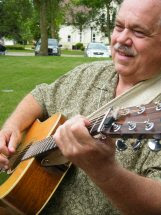
I remember reading an article about the fact that a musician listens to music 'differently' from other people and that even musicians differ if they are listening to a piece which features 'their instrument': the example given was a trumpet player listening to a trumpet concerto. I couldn't find that article, but this link explores similar themes: http://www.nytimes.com/2006/12/31/arts/music/31thom.html?pagewanted=1&ei=5070&en=d43df0d955119e0c&ex=1184904000
Listening to old time music affects the brain similarly, especially listening to 'source' music that was originally on 78s. As you listen more you start hearing the 'music' and not the limited acoustics of the medium. You also start hearing it differently from some one who is not familiar with this type of music.
Many of the songs that I've learned I heard originally from a 'secondary' source. In the last couple years I've started to listen to more original sources and often can compare several newer and older versions of the same songs. On a Troublesome Creek CD, a group we heard at last year's Winter Bluegrass Weekend, they list the group they originally heard do a song and the 'older' source. I'll do something similar with a few songs that Lynn and I perform. (Future CD liner notes?)
My Old Cottage Home: I learned this originally from Big Medicine (from the CD Too Old to be Controlled). On their version, the lead is sung by LaNelle Davis, their bass player at the time. I switched the key to G to fit my vocal range with Lynn and I singing 'full' duet on both voice and chorus. I also have the Carter family version and a 78 version on MP3 by John McGhee. (An aside, I saw Big Medicine again with a new bass player, and with a male vocalist, they were now singing it in G - the chorus as I recall is closer to John McGhee's version). I recently listened to all of the versions I had and also the one we did for our demo CD: on the demo we're doing it slower than any other version, although we've currently upped the tempo a bit. I also developed a Carter-style break and intro which I do in a low and higher octave. (This is one of the reasons I think I started doing - in G, the melody fits on the low strings in standard tuning - many of the 'low' breaks that Maybelle does are on a low-tuned guitar (1 to 1&1/2 steps lower than standard)). On Big Medicine's version, they feature mandolin, John McGhee's version features the fiddle and on the Carter Family version, AP is singing the lead and it sounds like Maybelle is doing finger style guitar. I know that if I had just heard the Carter Family version, I probably wouldn't have learned the song. I'm not a reconstructionist per se, and almost every song that I learn has something in it that appeals to me in a 'present-day' sort of way. I first heard this song when my mother was in a nursing home with Alzheimer's so the 2nd verse (with a reference to 'my mothers prayers') probably influenced my deciding to learn it. She died a year and a half ago so the 3rd verse also resonates ('one-by-one they have left that old cottage home'). We did it most recently in our South Dakota concert after paying a visit to my grandparents 'cottage home' in Twin Brooks, SD. In any event, the way Lynn and I currently do My Old Cottage Home differs considerably from Big Medicine's version as well as from the 'original' sources.
Lonesome Pine Special: I heard this first on a Hazel Dickens LP from the '70's on which she had two different 'bands' accompany her - one was a traditional country band, the other was Norman and Nancy Blake during their Rising Fawn String Band Period (sort of Baroque old time). The original appeal was partly Norman's rolling guitar breaks and the kind of sound they provided. Unfortunately, he was doing it in G position (key of B-flat) which suited Hazel's range, but not mine. Even open G was a bit high, so I ended up doing it in the key of F playing in C position with the capo on the 5th fret (Lynn plays in D with Capo on 3rd fret). This is case where the 'tune' has just as much appeal as the words, although since we were learning it during the 2004 election, some of our political friends turned the chorus "take me back to Texas" to 'send him back to Texas". I have also heard the original Carter family do this, but I haven't spent much time to listening to either version since I first learned it. Lynn and I sing full duet-mode for the verses and chorus and our current tempo is considerably faster than Hazel's version. Lynn has also worked out some neat bass runs (this is on our demo CD and myspace page so take a listen). We like it as an set opener and we've also used it for the duet contest.
Ain't Gonna Work Tomorrow: This is a Carter family song which I learned from the original Carter family version. I changed the arrangement slightly to use the title verse as the chorus (this is the last verse of the original). The last time I heard Foghorn play, they had added this to their repertoire, but I don't think they've recorded it yet (there version is different from ours, but they do have 'ain't gonna work' as a chorus). I learned the song because it matches my career goal (i.e. to retire or quit the day job). Although, Lynn points out that this guy who has 'lost the girl' is only gonna miss a day or two of work. I'm not too familiar with other versions, although I've heard at least one 'happy days' version on the radio where the guy's gonna miss work because he's getting 'married', not because the girl has 'gone and turned her back on me'. One of the things that I like about our version is that the guitar breaks I do are pretty close to old-time guitar bass runs. This is another one where Lynn and I do full duet treatment through-out and it is up-tempo so we can use it as a 'break' from some of our slower tunes.
Since Lynn and I are often singing to audiences that are not 'old time audiences', I like the fact that our treatment of an old time song seems to connect with people with different musical backgrounds. Like other groups, the Bob-i-Lynn band has a certain sound. If I hear a tune and especially a song from an band that I'm familiar with, I can usually identify the band even if I haven't heard the song before. This is true for contemporary old time bands such as Foghorn or Uncle Earl or some earlier groups like the Carter Family, Charlie Poole or the Delmore Brothers.
I'm probably too ADD to ever learn a guitar break or song exactly as it is played, although I do a number of things that are pretty close. Any song that I end up learning is something that I know I'm going to have to 'practice' dozens if not hundreds of times, so if it ends up in the repertoire it's gonna be something that I personally like a lot - there are many, many songs that I've started to learn that just don't hold up. Once I learn a song, I usually don't go back to compare it to the original - and when I do hear the original, I am always struck by how different our version has become.
Wednesday, July 18, 2007

Wednesday, July 11, 2007
Old Time Music (part 2)
Most of the 'traditional' or 0ld-time songs that I know were originally learned using secondary sources. My first exposure to this type of music was in high school during the 'folk boom'. I listened to Peter Paul & Mary, Kingston Trio... groups like that. With a couple of other high school buddies I was in a 'folk trio' with Guitar, Banjo and Bass. We played at 'hootenanny's', etc and we even made $90 once playing at a supermarket parking lot. In college, I also got into Doc Watson, Tom Paxton as well as the Beatles and other 'pop' groups. I also spent time in the summer going to a coffee house in Minneapolis and hearing Dave Ray, Leo Kottke and Blind Bill Lucas.
When Lynn and I moved to Minneapolis in 1970 (after a year of teaching high school in Montana), I started working as a bartender at the Black Forest Inn. There were some musicians among the regulars and workers who would get together and jam. One of the cooks did John Prine songs, a sculptor (Bruce Thomas) knew some Carter Family tunes, Noel Johnson sang blues tunes and I did some Doc Watson and other folks songs (Jesse James, Wabash Cannonball, etc). I did a few nursing home gigs with a college friend and Lynn and I did some duets (like Paxton's "last thing on my mind"). We lived in a house with a bunch of college friends - one of whom had a Green Brier Boys Album which is where I think I got 'Life is like a Mountain Railroad' and 'Amelia Earhart'.
In the 1970's there was a fairly vibrant acoustic music 'scene' in Mpls, especially on the West Bank, but I didn't really get into it; however, I do have a couple of LPs from era: Dakota Dave Hull & Sean Blackburn, etc. I've since gotten to know some of the musicians who were part of that scene, like Bob Douglas & Adam Granger (who were on the early Prairie Home Companion shows). Note that a lot of my listening in the 70's was to pop-folk singers like Linda Ronstadt, James Taylor, Joni Mitchell and Fleetwood Mac.
I also turned my focus to classical guitar: taking lessons and Music Theory classes at the U of M. In 1976 or so, a guitarist friend who had achieved what I was going for (MFA or some such), started looking for work in academia - he couldn't find anything so he took a job as a manager at a Perkins restaurant. So when the Black Forest decided they needed a front-in manager, I took the job and quit school (and gradually started playing more folk-oriented guitar).
In the 80's I was again busy with school (training for a software programming job) and kids (Alex born in 1978, Tommy in 1985). In 1986 or 1987 the church Lynn was going to started a variety show called 'The Lynnhurst Home Companion' - Lynn and I with a couple other musicians from church formed the 'Hot Dish String Band' which was the house band for the show. Every year we did 3 or 4 numbers including 'hokey' gospel numbers like 'Drop Kick Me Jesus' or 'We need a whole lot more of Jesus and a lot less rock and roll', but also one or tow folk and blue grass tunes. At these shows Lynn and I would usually do a duet as well.
This got me listening to more acoustic music and on the lookout for 'songs to sing': both for 'Hot Dish' and for the Bob-i-Lynn duet. I started getting CDs by Hot Rise, Laurie Lewis, Alison Krauss (before 'o brother' made her a relative mega-star) and other 'mainstream' bluegrass groups. We joined MBOTMA and started going to the August Bluegrass festival (where we started being 'exposed' to old time music as well as bluegrass ). In the early 90's Lynn and I took a couple of Bluegrass Jam classes with Brian Wicklund and Kevin Barnes (then members of Stoney Lonesome).
Of course, since MBOTMA is a bluegrass and oldtime music association, Lynn and I were also exposed to old time groups like Big Hoedown, Reeltime travelers and musicians like Bruce Molsky and Rayna Gellert -- we also started catching some of these groups when they came to Mpls to play at venues like the Cedar -- and I started adding "old-time" CDs to my collection.
During the dotcom boom my company split in two and I went with the 'dotcom' company - with the bust in 2001, I was laid off but was fortunately hired by the 'software' side and resumed work within 3 weeks. During my 'career' years I'd spent a lot of time learning new skills on off hours. After the layoff routine, I decided to start devoting that time to guitar, mandolin and learning new songs and tunes. I re-learned words to many songs I'd sung before and decided to learn new songs based on whatever I was into at the time. I was on a Norman Blake kick for while so learned a few he wrote as well as his take on traditional songs.
My mandolin skills were improving playing for folk dances and I started learning more fiddle tunes on mandolin. Although I had been flat-picking a few tunes on guitar for many years, I became more focused in 2003 when MBOTMA started sponsoring the duet/flat-picking contest at the state fair. I started going to flat-picking jams and have 'won' the senior championship for a few years (there have usually been only a couple of entries in the over 56 category). Lynn and I also took part in the duet contests and came in 3rd last year!.
As Lynn and I started playing out, I started looking for songs that would work as duets. Looking for something different, I started getting old LPs on e-bay - in some cases they were bluegrass and old time bands from the 70s and 80s in other cases collections of 78s. A friend also gave me CDs with 4 or 5 of the New City Lost Ramblers (transcribed from his LP collection). I also got CDs of the complete Carter Family and early Delmore brothers. Often we'd learn a song based on a contemporary rendition, but I'd also listen to an older source.
Last November, I got an IPod for my birthday (thanks! Lynn& Alex), and I have put most of my CD collection and some of my LP collection on it. (over 7,000 songs). On walks and at work I listen to it in shuffle mode and make note of something that might work as a Bob-i-Lynn tune. (Especially with CD Collections or CD-ROM mp3's of 78s, I might hear something for the first time on the IPod).
Thus, for some of our recent songs, we are learning songs from an original source (or at least a source recorded in the 20s or 30s), rather than from an 'interpretation'. In at least one case hearing the 'original' has led me to put a song on the 'to consider' list, even though I had heard several other groups do it before (This is 'Bear Creek' from the Carter Family- I'm trying to come up with something similar to Maybelle's guitar part but so far it's still in the 'working on' category).
Currently my way of tracking a song 'to consider' is to create a new document in Google Docs with at least the title (and often with whatever words I can grab on the internet). Of the 60 or more songs I've considered over the last 9 months, about 3 or 4 have actually gotten into our repertoire.
This post has been a sort of musical autobiography - next time I'll talk a bit about bringing a song from the 'to consider stage' to actually performing it and what the heck all this has to do with old-time purists, etc.
When Lynn and I moved to Minneapolis in 1970 (after a year of teaching high school in Montana), I started working as a bartender at the Black Forest Inn. There were some musicians among the regulars and workers who would get together and jam. One of the cooks did John Prine songs, a sculptor (Bruce Thomas) knew some Carter Family tunes, Noel Johnson sang blues tunes and I did some Doc Watson and other folks songs (Jesse James, Wabash Cannonball, etc). I did a few nursing home gigs with a college friend and Lynn and I did some duets (like Paxton's "last thing on my mind"). We lived in a house with a bunch of college friends - one of whom had a Green Brier Boys Album which is where I think I got 'Life is like a Mountain Railroad' and 'Amelia Earhart'.
In the 1970's there was a fairly vibrant acoustic music 'scene' in Mpls, especially on the West Bank, but I didn't really get into it; however, I do have a couple of LPs from era: Dakota Dave Hull & Sean Blackburn, etc. I've since gotten to know some of the musicians who were part of that scene, like Bob Douglas & Adam Granger (who were on the early Prairie Home Companion shows). Note that a lot of my listening in the 70's was to pop-folk singers like Linda Ronstadt, James Taylor, Joni Mitchell and Fleetwood Mac.
I also turned my focus to classical guitar: taking lessons and Music Theory classes at the U of M. In 1976 or so, a guitarist friend who had achieved what I was going for (MFA or some such), started looking for work in academia - he couldn't find anything so he took a job as a manager at a Perkins restaurant. So when the Black Forest decided they needed a front-in manager, I took the job and quit school (and gradually started playing more folk-oriented guitar).
In the 80's I was again busy with school (training for a software programming job) and kids (Alex born in 1978, Tommy in 1985). In 1986 or 1987 the church Lynn was going to started a variety show called 'The Lynnhurst Home Companion' - Lynn and I with a couple other musicians from church formed the 'Hot Dish String Band' which was the house band for the show. Every year we did 3 or 4 numbers including 'hokey' gospel numbers like 'Drop Kick Me Jesus' or 'We need a whole lot more of Jesus and a lot less rock and roll', but also one or tow folk and blue grass tunes. At these shows Lynn and I would usually do a duet as well.
This got me listening to more acoustic music and on the lookout for 'songs to sing': both for 'Hot Dish' and for the Bob-i-Lynn duet. I started getting CDs by Hot Rise, Laurie Lewis, Alison Krauss (before 'o brother' made her a relative mega-star) and other 'mainstream' bluegrass groups. We joined MBOTMA and started going to the August Bluegrass festival (where we started being 'exposed' to old time music as well as bluegrass ). In the early 90's Lynn and I took a couple of Bluegrass Jam classes with Brian Wicklund and Kevin Barnes (then members of Stoney Lonesome).
Of course, since MBOTMA is a bluegrass and oldtime music association, Lynn and I were also exposed to old time groups like Big Hoedown, Reeltime travelers and musicians like Bruce Molsky and Rayna Gellert -- we also started catching some of these groups when they came to Mpls to play at venues like the Cedar -- and I started adding "old-time" CDs to my collection.
During the dotcom boom my company split in two and I went with the 'dotcom' company - with the bust in 2001, I was laid off but was fortunately hired by the 'software' side and resumed work within 3 weeks. During my 'career' years I'd spent a lot of time learning new skills on off hours. After the layoff routine, I decided to start devoting that time to guitar, mandolin and learning new songs and tunes. I re-learned words to many songs I'd sung before and decided to learn new songs based on whatever I was into at the time. I was on a Norman Blake kick for while so learned a few he wrote as well as his take on traditional songs.
My mandolin skills were improving playing for folk dances and I started learning more fiddle tunes on mandolin. Although I had been flat-picking a few tunes on guitar for many years, I became more focused in 2003 when MBOTMA started sponsoring the duet/flat-picking contest at the state fair. I started going to flat-picking jams and have 'won' the senior championship for a few years (there have usually been only a couple of entries in the over 56 category). Lynn and I also took part in the duet contests and came in 3rd last year!.
As Lynn and I started playing out, I started looking for songs that would work as duets. Looking for something different, I started getting old LPs on e-bay - in some cases they were bluegrass and old time bands from the 70s and 80s in other cases collections of 78s. A friend also gave me CDs with 4 or 5 of the New City Lost Ramblers (transcribed from his LP collection). I also got CDs of the complete Carter Family and early Delmore brothers. Often we'd learn a song based on a contemporary rendition, but I'd also listen to an older source.
Last November, I got an IPod for my birthday (thanks! Lynn& Alex), and I have put most of my CD collection and some of my LP collection on it. (over 7,000 songs). On walks and at work I listen to it in shuffle mode and make note of something that might work as a Bob-i-Lynn tune. (Especially with CD Collections or CD-ROM mp3's of 78s, I might hear something for the first time on the IPod).
Thus, for some of our recent songs, we are learning songs from an original source (or at least a source recorded in the 20s or 30s), rather than from an 'interpretation'. In at least one case hearing the 'original' has led me to put a song on the 'to consider' list, even though I had heard several other groups do it before (This is 'Bear Creek' from the Carter Family- I'm trying to come up with something similar to Maybelle's guitar part but so far it's still in the 'working on' category).
Currently my way of tracking a song 'to consider' is to create a new document in Google Docs with at least the title (and often with whatever words I can grab on the internet). Of the 60 or more songs I've considered over the last 9 months, about 3 or 4 have actually gotten into our repertoire.
This post has been a sort of musical autobiography - next time I'll talk a bit about bringing a song from the 'to consider stage' to actually performing it and what the heck all this has to do with old-time purists, etc.
Monday, July 9, 2007
You know you're getting old when you list your son as your emergency contact
Getting ready for an eye exam, I was filling out the forms and came to the Emergency Contact Field (someone other than your spouse living at a different address). I have usually listed one of my sisters, but then I thought: why not Alex -- he's employed, owns a house, a hybrid car and is certainly more stable then I am. So a new first in the aging process: listing your son as the 'emergency contact'. Of course, soon enough he'll be driving me to all of these doctor appointments .
Which reminds me - why do I have to keep filling out forms with information that already exists in electronic format? My day job consists of writing software that transfers information from one computer to another and I even wrote a module specifically to transfer medical documents while adhering to HIPPA (privacy) guidelines - Holy Inefficiency Batman! - and folks wonder why health care costs keep going up.
Which reminds me - why do I have to keep filling out forms with information that already exists in electronic format? My day job consists of writing software that transfers information from one computer to another and I even wrote a module specifically to transfer medical documents while adhering to HIPPA (privacy) guidelines - Holy Inefficiency Batman! - and folks wonder why health care costs keep going up.
Monday, July 2, 2007
Old Time Music (part 1)
Lynn and I have been members of the Minnesota Bluegrass and Old Time Music Association (MBOTMA) for over 15 years and a few years ago, became a MBOTMA 'member' band. When we first joined, my main interest was bluegrass: in the early 90's we took a bluegrass jam class offered by Brian Wicklund and Kevin Barnes, then members of Stoney Lonesome. But over the years I became more interested in 'old time' music and as a duo, Lynn and I focus mostly on the old-time tradition. MBOTMA has 3 categories for band: Bluegrass, Old-time and Related - we registered as an old-time band, mostly because most of the new songs we were learning - Carter Family, Delmore Brothers, etc - were firmly in the 'old-time' tradition.
Something I read in the Old-Time Herald a few months back got me to thinking about what it means to perform music in the 'old-time' tradition. It was a review of a CD and the reviewer was bemoaning the fact that the music didn't sound exactly like some performance she'd heard on a 78 - she said something more or less like 'I suppose folk must make new recordings' (some day I'll find that review and put the exact quotes here). When we were at Lanesboro I was also in a couple conversations with people bemoaning the fact that so-and-so was 'beatifying' the sound in order to make it more palatable. So I did a little checking around to find out how 'old time' music was defined. Two links seem to do a good job of defining it:
http://www.oldtimemusic.com/otdef.html
http://mikeseeger.info/html/oldtime.html
I like this comment from the old time music link:
Resonant in meaning and methodology, `old time music' had been the heartbeat of Anglo-Celtic Southern America for many generations. By the time it became a marketing label which celebrated its own quaintness, its days were numbered. The technology which enables us to savor Fiddlin' John Carson 70 years after his heyday also heralded the demise of the charmed circle of oral tradition and relative isolation which had nurtured old time music since the coming of the South's first Anglo-Celtic settlers.
Thus the direct record of old time music can be thought of as the 78 recordings of the 1920's and 1930's - however, this is just a snapshot of music that had been played and evolved throughout the 18th,19th and early 20th century: for the most part, these recordings were commercial - they were made to sell. Field recordings may give a better insight into non-commercial music, but the earliest date from the 20th century on as well. Thus to state categorically that old time music done in this small window is the only way to do it seems extreme: I am willing to grant a great deal more lee-way to how old-time music should sound and be performed.
Mike Seeger's comments were originally published about 10 years ago in Bluegrass Unlimited and is addressed to bluegrass fans: he gives a number of recordings of old-time music that would give a bluegrass fan a sense of the 'roots' of bluegrass. His comment that 'speaks to me' is:
I suspect that many of us play this older style music for some of the same reasons that most bluegrass musicians play bluegrass, because we like it and it fits us. We can think of all kinds of reasons such as "I was raised with it," "I like its sound," "I like to be able to play the music myself or with friends without plugging in," and I can add "it's timeless, meaningful and I value its continuity with the past." All of those and more fit me. I can talk on and on about reasons for liking old-time and bluegrass music but really it all boils down to "it just suits me."
Although I didn't really set out to be an old-time musician, I'm finding more and more that "it just suits me". One final quote from Kenny Jackson's Web site sums it up for me for now:
Old-time music is now found in American families from diverse backgrounds, and while it recalls bygone times and places, it's also very much a living, contemporary music. Most of my friends play and sing it, and I can't think of old-time music without also thinking of those good friends whom I'll meet up with at fiddlers conventions and festivals, or in kitchens and on front porches, going late into the night leaning into long, wild fiddle tunes, and singing tragic old ballads, heart songs, banjo songs, blues.
Old-time music may have a name that would make it seem something from bygone eras—and yes, it does invoke spirits of the past—but it continues to be the most exciting, relevent, and in-the-moment musical experience of many people's lives. And I'm glad to be one of them!
http://www.kenejackson.com/
(more in a later post I'm sure)
Something I read in the Old-Time Herald a few months back got me to thinking about what it means to perform music in the 'old-time' tradition. It was a review of a CD and the reviewer was bemoaning the fact that the music didn't sound exactly like some performance she'd heard on a 78 - she said something more or less like 'I suppose folk must make new recordings' (some day I'll find that review and put the exact quotes here). When we were at Lanesboro I was also in a couple conversations with people bemoaning the fact that so-and-so was 'beatifying' the sound in order to make it more palatable. So I did a little checking around to find out how 'old time' music was defined. Two links seem to do a good job of defining it:
http://www.oldtimemusic.com/otdef.html
http://mikeseeger.info/html/oldtime.html
I like this comment from the old time music link:
Resonant in meaning and methodology, `old time music' had been the heartbeat of Anglo-Celtic Southern America for many generations. By the time it became a marketing label which celebrated its own quaintness, its days were numbered. The technology which enables us to savor Fiddlin' John Carson 70 years after his heyday also heralded the demise of the charmed circle of oral tradition and relative isolation which had nurtured old time music since the coming of the South's first Anglo-Celtic settlers.
Thus the direct record of old time music can be thought of as the 78 recordings of the 1920's and 1930's - however, this is just a snapshot of music that had been played and evolved throughout the 18th,19th and early 20th century: for the most part, these recordings were commercial - they were made to sell. Field recordings may give a better insight into non-commercial music, but the earliest date from the 20th century on as well. Thus to state categorically that old time music done in this small window is the only way to do it seems extreme: I am willing to grant a great deal more lee-way to how old-time music should sound and be performed.
Mike Seeger's comments were originally published about 10 years ago in Bluegrass Unlimited and is addressed to bluegrass fans: he gives a number of recordings of old-time music that would give a bluegrass fan a sense of the 'roots' of bluegrass. His comment that 'speaks to me' is:
I suspect that many of us play this older style music for some of the same reasons that most bluegrass musicians play bluegrass, because we like it and it fits us. We can think of all kinds of reasons such as "I was raised with it," "I like its sound," "I like to be able to play the music myself or with friends without plugging in," and I can add "it's timeless, meaningful and I value its continuity with the past." All of those and more fit me. I can talk on and on about reasons for liking old-time and bluegrass music but really it all boils down to "it just suits me."
Although I didn't really set out to be an old-time musician, I'm finding more and more that "it just suits me". One final quote from Kenny Jackson's Web site sums it up for me for now:
Old-time music is now found in American families from diverse backgrounds, and while it recalls bygone times and places, it's also very much a living, contemporary music. Most of my friends play and sing it, and I can't think of old-time music without also thinking of those good friends whom I'll meet up with at fiddlers conventions and festivals, or in kitchens and on front porches, going late into the night leaning into long, wild fiddle tunes, and singing tragic old ballads, heart songs, banjo songs, blues.
Old-time music may have a name that would make it seem something from bygone eras—and yes, it does invoke spirits of the past—but it continues to be the most exciting, relevent, and in-the-moment musical experience of many people's lives. And I'm glad to be one of them!
http://www.kenejackson.com/
(more in a later post I'm sure)
Wednesday, June 27, 2007
Old School
We were the opening act on the acoustic stage at the stone arch festival on June 16th. Following us was Jonathan Delahanty, a young singer song-writer that I first met at Java Jack's at 'the Hoot'. At some point he refered to us as doing 'old shool' music. I didn't think much of it as the time, since we are 'old time' musicians. However, this week I saw an Onion headline/article referencing "Old School", the movie (with Will Ferrell) and wondered if there was something more going on. I also looked up the movie on wikipedia and realized that it is one of the few that I have seen in recent years: probably on video with one or both of my sons. Like most old-time musicians I don't watch much TV (on stage, many claim not to own one*) and don't see a lot of movies (too busy playing music or going to hear it!). However, in San Francisco we went with Tommy to see Blades of Glory, another Will Ferrell pic; I thought it was a hoot (of course I don't get out much). Here are the links to the Onion article and Wikipedia (warning: adult language and situations -- and... the ending is given away)
http://www.theonion.com/content/news_briefs/report_fbi_learns_of_plot
http://en.wikipedia.org/wiki/Old_School_(film)
* on stage at the Cedar: Abigail Washburn(Uncle Earl) and Martha Scanlan (formerly of Reeltime Travelers) both said that they do not own a TV. Our TV is in the basement and not watched much at all - according to what I've read it and all other 'analog' TV's will be obsolete in 2009.
http://www.theonion.com/content/news_briefs/report_fbi_learns_of_plot
http://en.wikipedia.org/wiki/Old_School_(film)
* on stage at the Cedar: Abigail Washburn(Uncle Earl) and Martha Scanlan (formerly of Reeltime Travelers) both said that they do not own a TV. Our TV is in the basement and not watched much at all - according to what I've read it and all other 'analog' TV's will be obsolete in 2009.
Monday, June 25, 2007
Danebod
I just got back from a week at 'Danebod Family Camp', in Tyler, MN. This is something we've been going to since 1996 - it's always a lot of fun, but is a bit hard to explain - the Danebod web site has a brief description: http://danebod.org/aboutus.html
This year, I was in charge of the folk band - there were four days of 'rehearsals' plus playing for dances. Most of the key people don't actually rehearse, since we do mostly the same dance tunes every year. However, a number of people who hadn't played with the folk band before showed up and I tried to go over tunes that we might play in a dance that day or evening. During the dances, Dave (who is the 'founder' of the band and a dance caller), did most of the work setting tempos and determining when we cut off, etc. For the most part I'm playing mandolin or banjo in the middle of it all, so it doesn't really work to 'conduct'.
The family dance on Wednesday at 8:00 pm was the 'official' time for the 'family' band to play and I think most people who showed up at rehearsal were on stage at one time or another. Lynn said she counted 15 at one point. (Usually 6 or 7 is sufficient). Our band name that night was 'Bob and his extremely large orchestra'.
I also conducted some extra rehearsal for the 'advanced' band which played for the Wednesday late night dance (about 10:15-11:30 pm). The dances Wednesday were called by Robin, a caller that we've worked with at Tapestry and other venues. She calls mostly contra dances, so we were using tunes from the Danebodium repertoire. Ken, Lynn, Daniel and I (the official members of Danebodium) were all there - plus Peter played guitar on most pieces and Neal played guitar on a few others. Paul played bodhran and Valerie played on a couple of the sets. I received many positive comments on the music and dances for that night and it sure looked like everyone dancing was having a good time.
I'll probably be leader of the band for a couple of more years. I'm thinking of reviving the practice of sending out 'family band' music ahead of time, probably starting with 'classics' rather than new music. It would be nice to do some coordination ahead of time with whomever is doing the family or barn dance on Wednesday. The idea is that newbies would be invited to play on the 'classics' tunes, but should plan to dance on other tunes. Yes, Virginia, there are times when newbies play on tunes that they are not quite up to speed on (both this year and previous). Of course, with an all-volunteer band, you can't really 'enforce' these kinds of rules, but you can offer 'suggestions'.
A big deal for me this year was actually dancing (when the band wasn't playing). For the last two years I've been nursing a pulled leg muscle and although I still limp a bit ( I officially have arthritis in my right hip), I was able to dance for pretty much as long as I cared to. Shira taught 'Turkish Kiss' the first night at late-late night dancing. This is an Israeli line dance that has become a camp classic. Shira's dances are complicated: usually with 3 major sections each of which contain several elements - (for both your arms and legs). Since she did a step-by-step set of instructions I was sort of able to get it. This encouraged me enough to attend her dance workshop on Tuesday morning where I sort of learned two of her new dances. Of course I couldn't do this independently nor did I do all the steps and arm movements perfectly, but I did dance these dances whenever they came up and thoroughly enjoyed myself. The key of course, is to watch Shira or one of the young folk (usually a young woman) and do what they do. In addition from going from 0 to 3 Shira dances, I also learned the 'Salsa' (which was taught last year) and a new dance by Dave (officially called Broken Horse or some such, but we called it the counting dance - you keep switching partners by counting up to 4).
It was Lynn's turn to 'play hurt' - she's been in physical therapy for her shoulder (too much piano playing this winter) -then the Friday before we left she developed a 'floater' in her eye (she called the opthamologist on call on Saturday who assured it was part of the normal aging process). Then on Sunday, as we were packing, she stubbed her toe - when the swelling subsided on Wednesday, she also was pretty she had broken it (and stopped dancing on it!). Still, like a few other things, an imperfect week at Danebod sure beats the hell out of not going.
She did comment that I looked to be thoroughly enjoying myself. I do believe that part of it was that we were so busy performing prior to going, that I had didn't have any time to set up any expectations. There are some people who anticipate events like these and set themselves up for disappointment - often, they expect some mystical, magical, transcendent experience that reality can never match. (I am usually but not always immune from this type of behavior.) This year, my focus was on several 'big' bob-i-lynn performances culminating in the MBOTMA homegrown kickoff at the beginning of June and a performance at the Stonearch festival the day prior to leaving for camp. I thus had zero time to think about the ideal Danebod experience before we were on the road on Sunday. Not sure if I can manage it every year, but its a good wapproach to take. I also think that my emerging 2nd (or is it 3rd) career as a working musician means that more of my everyday life is Danebod-like and I'm not looking at it as a point of salvation for an otherwise crappy life (lets hope I can keep that attitude as well).
In any event, by the last dayI was ready to go home and sleep in my own bed (with only a few feet to the bathroom).
This year, I was in charge of the folk band - there were four days of 'rehearsals' plus playing for dances. Most of the key people don't actually rehearse, since we do mostly the same dance tunes every year. However, a number of people who hadn't played with the folk band before showed up and I tried to go over tunes that we might play in a dance that day or evening. During the dances, Dave (who is the 'founder' of the band and a dance caller), did most of the work setting tempos and determining when we cut off, etc. For the most part I'm playing mandolin or banjo in the middle of it all, so it doesn't really work to 'conduct'.
The family dance on Wednesday at 8:00 pm was the 'official' time for the 'family' band to play and I think most people who showed up at rehearsal were on stage at one time or another. Lynn said she counted 15 at one point. (Usually 6 or 7 is sufficient). Our band name that night was 'Bob and his extremely large orchestra'.
I also conducted some extra rehearsal for the 'advanced' band which played for the Wednesday late night dance (about 10:15-11:30 pm). The dances Wednesday were called by Robin, a caller that we've worked with at Tapestry and other venues. She calls mostly contra dances, so we were using tunes from the Danebodium repertoire. Ken, Lynn, Daniel and I (the official members of Danebodium) were all there - plus Peter played guitar on most pieces and Neal played guitar on a few others. Paul played bodhran and Valerie played on a couple of the sets. I received many positive comments on the music and dances for that night and it sure looked like everyone dancing was having a good time.
I'll probably be leader of the band for a couple of more years. I'm thinking of reviving the practice of sending out 'family band' music ahead of time, probably starting with 'classics' rather than new music. It would be nice to do some coordination ahead of time with whomever is doing the family or barn dance on Wednesday. The idea is that newbies would be invited to play on the 'classics' tunes, but should plan to dance on other tunes. Yes, Virginia, there are times when newbies play on tunes that they are not quite up to speed on (both this year and previous). Of course, with an all-volunteer band, you can't really 'enforce' these kinds of rules, but you can offer 'suggestions'.
A big deal for me this year was actually dancing (when the band wasn't playing). For the last two years I've been nursing a pulled leg muscle and although I still limp a bit ( I officially have arthritis in my right hip), I was able to dance for pretty much as long as I cared to. Shira taught 'Turkish Kiss' the first night at late-late night dancing. This is an Israeli line dance that has become a camp classic. Shira's dances are complicated: usually with 3 major sections each of which contain several elements - (for both your arms and legs). Since she did a step-by-step set of instructions I was sort of able to get it. This encouraged me enough to attend her dance workshop on Tuesday morning where I sort of learned two of her new dances. Of course I couldn't do this independently nor did I do all the steps and arm movements perfectly, but I did dance these dances whenever they came up and thoroughly enjoyed myself. The key of course, is to watch Shira or one of the young folk (usually a young woman) and do what they do. In addition from going from 0 to 3 Shira dances, I also learned the 'Salsa' (which was taught last year) and a new dance by Dave (officially called Broken Horse or some such, but we called it the counting dance - you keep switching partners by counting up to 4).
It was Lynn's turn to 'play hurt' - she's been in physical therapy for her shoulder (too much piano playing this winter) -then the Friday before we left she developed a 'floater' in her eye (she called the opthamologist on call on Saturday who assured it was part of the normal aging process
She did comment that I looked to be thoroughly enjoying myself. I do believe that part of it was that we were so busy performing prior to going, that I had didn't have any time to set up any expectations. There are some people who anticipate events like these and set themselves up for disappointment - often, they expect some mystical, magical, transcendent experience that reality can never match. (I am usually but not always immune from this type of behavior.) This year, my focus was on several 'big' bob-i-lynn performances culminating in the MBOTMA
In any event, by the last dayI was ready to go home and sleep in my own bed (with only a few feet to the bathroom).
Wednesday, June 13, 2007
Farewell to Mr. Wizard
At Cuppa Java this morning, the TV had a picture of a man named Don Herbert who had just died. I was trying to figure out who he was but didn't make the connection untilI got home and read the paper: Mr Wizard died at age 89 - NBC was showing a picture of him as an older man, but here's the picture I remember:

He was on from 1951-1964 in "Watch Mr Wizard" and I know I watched it a bunch, but don't recall many details. There was usually a couple of kids (at least one girl and one boy), and at some point in every show one would say to the other: "Let's ask Mr. Wizard". This makes me wonder if this influenced my life-long interest in science: I never took any Physics, Chemistry or Biology past high shool but I do subscribe to (and read) Scientific American. The Strib account describes the show as a 'fond Baby Boomer memory' so I am sure I'm not alone. He was born in Waconia, MN where my dad had a sailboat for a number of years.
update - here's a posting with much more detail than I could manage: http://www.huffingtonpost.com/marty-kaplan/watch-mr-wizard_b_51964.html

He was on from 1951-1964 in "Watch Mr Wizard" and I know I watched it a bunch, but don't recall many details. There was usually a couple of kids (at least one girl and one boy), and at some point in every show one would say to the other: "Let's ask Mr. Wizard". This makes me wonder if this influenced my life-long interest in science: I never took any Physics, Chemistry or Biology past high shool but I do subscribe to (and read) Scientific American. The Strib account describes the show as a 'fond Baby Boomer memory' so I am sure I'm not alone. He was born in Waconia, MN where my dad had a sailboat for a number of years.
update - here's a posting with much more detail than I could manage: http://www.huffingtonpost.com/marty-kaplan/watch-mr-wizard_b_51964.html
Subscribe to:
Posts (Atom)